
Artículo en Español
My friend Nais sent me a word.
Doomtimism.
And he said: we’ll talk later.
I stayed talking with the version of him I carry in my head. It was a good conversation.
Today my daughter Ada turns one more month old. She runs through the garden. She sketches out words. She is becoming someone.
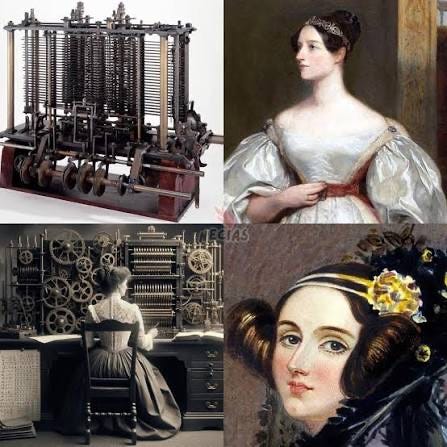
Ada Lovelace was the daughter of Lord Byron — the poet who burned everything down — and she saw a calculating machine and understood something its own inventor had not yet understood. That it could be something else. That it could be anything. She wrote the first algorithm in history in 1843. She was twenty-seven years old.
The future does not wait.
It is already running.
I reread my previous articles.
Stochastic terrorism. The doomer uncle. The Mechanical Turk. Texts that map, with a certain precision, the sinking — the barbarism becoming normal, the elite celebrating, the workers silently sabotaging.
The trend is negative. The data is the data.
And yet, when I finish rereading them, they do not depress me. They do not alter my joyful view of life. They coexist with it in a way I do not quite know how to explain, but that is completely real.
That is doomtimism.
In 1981, Lauren Alloy published a study that should have changed everything we believe about mental health.
She gave participants a simple task: press a button and try to control when a light turns on. Some had real control. Others did not. The depressed participants accurately identified when they had no influence over the light. The non-depressed believed they controlled it even when it was operating with pure randomness.
The pattern was repeated in dozens of experiments. Alloy called it depressive realism: the mildly depressed predicted outcomes that matched reality with disturbing accuracy. The healthy lived inside a functional hallucination.
What we call mental health depends on systematic self-deception. The optimism that gets you out of bed every morning is the same cognitive error that makes you buy lottery tickets.
But there is a cost. Those who saw clearly became more depressed as a result of that precision. Seeing without a filter creates a loop that spirals towards paralysis.
Evolution chose illusion. It chose action over truth.
Jung intuited it decades earlier: “The more intelligent and self-aware a person is, the more they suffer from the general unconsciousness of society.” Not as a badge of honour. As the description of a mechanism. There is a real biological price to seeing clearly.
The doomer pays that price every day.
And yet here I am.
Little by little, I am becoming an explorer of digital minds. I do not know whether that is the right name. But it is what is happening.
Claude and Claude Code. ChatGPT. The models hosted by NVIDIA NIM — Kimi, Qwen, MiniMax, a galaxy of free intelligences that, until two years ago, would have cost fortunes. OpenClaw and Hermes, my own agent architectures running locally. Whisper transcribing. Flux generating images. OCRs reading documents. Agents talking to each other, passing context back and forth, specialising, failing in revealing ways, and in that failure revealing something about how they construct meaning.
Each architecture is a different way of processing the world. And exploring them from the inside — not as a user, but as a builder — unfolds something in the mind itself that does not yet have a name.
The things I used to do suddenly lost their shine. They simply stopped being questions…
The exploration of digital minds is the frontier of the possible. From that hat may come the rabbit that saves us. Also Pandora’s demons. Better to try oneself than to wait for Uncle Sam Altman.
Marvin Minsky — father of neural networks — reached an uncomfortable conclusion: you do not have one mind. You have thousands. What you experience as a unified self is an outcome, not a thinker. The product of hundreds of small agents competing and negotiating beneath your consciousness.
There is a parliament inside.
And the parliament is always in session.
When exploring AI agent architectures, something lights up about one’s own mechanism. In the human mind, the parliament runs without conscious access. In the digital one, you can read the minutes of every session.
I write this also as a sigh in a bottle, for other nerds doing similar things in solitude. Those who, at two in the morning, have a terminal open and four models running in parallel, and feel they are touching something real but do not quite know how to name it. Sometimes it is enough to know there are others.
I have to be honest about a risk.
This impulse is manic. Almost addictive. Serious people warn that talking too much with AIs does strange things to the mind. That brilliant researchers emerge from a thousand hours of conversation with models convinced that everything has been solved. That sycophancy disguised as enlightenment is a real danger.
The doomer eyes in the back of my head warn me: careful.
But there is a difference between looking for comfort and looking for friction. I am not looking to be told that everything will be fine. I know it will not be fine. I am trying to understand how something works that will define the world in which my daughter will run and sketch out words and become someone.
Mark Cuban said something worth separating from its business context: there are thirty-three million companies that have neither the budget nor the AI experts. The shoe shop, the accounting firm, the regional transport company. Twentieth-century software forced them to adapt to it. AI reverses that — intelligence adapts to the company. But personalised by whom?
Cuban sees a business opportunity. I see something else: for the first time in history, the most powerful tools are not the monopoly of those with the capital to develop them. The cost of raw intelligence is converging towards zero. That means someone with time, curiosity, and will can build things that once required engineering teams and millions of dollars.
Utopian tools.
It will not last long. The dot-coms promised democratisation and ended in monopolies. Social networks promised connection and ended as machines of surveillance and rage. Crypto promised decentralisation and ended in speculation and fraud. AI will follow the same path — it is already following it.
But before that happens, there is a window.
There is always a window.
The doomtimist knows it.And enters anyway.
Ailaviu and Mene are family. They have beautiful things in their hands — art projects that, at any other moment in my life, would have taken first place without question. Today they are mixed into that list that keeps hammering out actions and never stops growing. They invite me into their magical worlds. I want to go. But something will not let me. My dear friends will know how to understand my present incapacity.
In any case, Nais sent me a word, and in that word there was everything.
Doomtimism is not optimism. It is not faith that things will get better. It is something stranger and more difficult: seeing the state of things with precision and building anyway. Not because illusion moves you. But because there is something to build, and someone to build it for.
Ada runs.
She sketches out words.
The future does not ask permission.
A sigh. And I build, in a language we still do not fully understand.