Stochastic Terrorism
Terrorismo Estocástico

Today I came across the term stochastic terrorism. I looked it up, read what it meant, and it had the effect certain words sometimes have: not teaching you something new, but giving a name to something you already knew.
It is a very Silicon Valley term. Like effective altruism, like disruption, like existential risk. Words that sound like discovery and smell like branding. Words that arrive wrapped in the feeling that someone, in some Palo Alto garage, has just formulated for the first time something the world had been suffering for centuries without knowing how to name.

But the phenomenon is not new. It is as old as the feudal lord who exercised the so-called right of the first night over the farmer’s wife, convinced that his station made any whim legitimate. Until the farmer—or the whole village, as in Fuenteovejuna—decided otherwise. Luigi Mangione, the kid who killed the CEO of UnitedHealthcare on a Manhattan street, was not an accident or an anomaly. He was a response. A William Wallace without the kilt, a William Tell without the arrow, but with the same ancient grammar: that of the subjugated person who, at some point, reckons he has nothing left to lose.
Stochastic terrorism is the new name for that grammar.
As a child, I had the impression that the true administrators of violence preferred anonymity. Serious power did not need to show itself: it financed, conditioned, intervened. It dressed soberly, spoke of innovation, of security, of progress. I believed that for a long time. Then, over the course of my life, I watched that reserve wear away. I watched brazenness grow slowly, then faster, then without restraint. Until we arrived here, which deserves no name other than abomination: a segment of the technological and military elites of the West that has abandoned all shame and adopted, with an obscenity increasingly visible, the mannerisms of the rockstar, the corporate strongman, the lord who no longer even bothers to disguise his contempt for the world he administers.
It is not enough to read this turn as a fad among eccentric millionaires. What becomes visible there is a deeper political mutation: the fusion of technological capital, the arms industry, mass communication platforms, and open fantasies of domination. Power used to prefer the antiseptic tone of the manager; now it takes pleasure in the insolence of the boss who knows he is untouchable. Brazenness itself begins to function as proof of authority.
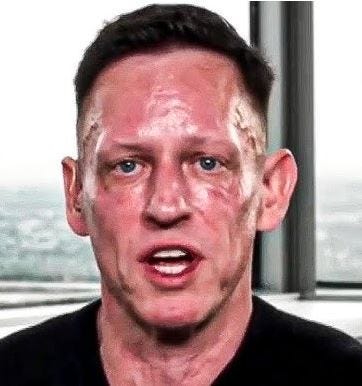
That is why certain figures now appear as almost too precise emblems of the age. Peter Thiel, the Antichrist—and this is not a metaphor but a clinical observation: Thiel himself brought up the subject on a podcast, and while discoursing on the end times he started turning red, sweat shining on his forehead, and right there, on camera, two horns began to grow. Literally. Two protrusions pulsing above his brows, like Hellboy in a tech-bro T-shirt. The body confirming what philosophy barely dared to suggest. Alex Crap, messianic merchant of surveillance and prediction, presenting the machinery of extermination with the air of a corporate grifter who sells you software and tantra with sexual abuse thrown in. Elon Musk, imperial buffoon controlling satellites and platforms with planetary reach, high on ketamine all day, with his hand in military coffers for every one of his companies, and meddling in elections everywhere without the slightest resistance. And finally, with a small honourable mention, the head of Anduril, a Rumpelstiltskin dwarf of computational war, manufacturing lethal toys for an order of whim and devastation that can at last afford not to disguise anything.
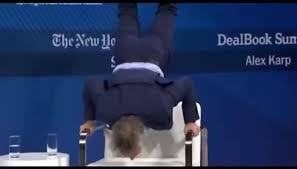
In all of them there is something more than wealth or eccentricity. There is lordship. They speak like proprietors of the century. Their political imagination is inhabited not by citizens but by users; it imagines not community but obedience legible to systems.
Lordship is not only an economic arrangement: it is also a dramaturgy of power. The lord had to be seen dominating. He had to display arbitrariness, exceptional rights, the ability to reward and punish. That ancient scene now returns in new materials. The court no longer revolves around a castle, but around platforms, funds, contractors, private armies, and ministries of war. What remains is the central gesture: that they see you obey, and that you see you have no other choice.
The same disposition now extends into politics with ever more savage frankness.
Trump turned cruelty into a style of rule and the degradation of others into a mass ceremony. Israel’s rulers—Netanyahu, Gallant, the satanic Ben Gvir and Smotrich, that accountant of the apocalypse who administers hunger with a spreadsheet—embody a politics that is not content merely to exercise asymmetry: it needs to celebrate it, turn it into an example, convert it into law.
Violence no longer appears as collateral damage of power. It appears as self-affirmation. As pedagogy. As a visible reminder of the classes of human and subhuman. Of blue blood and brown blood.
That mechanism becomes unbearably clear in Gaza. For generations, a logic of confinement, periodic punishment, and systematic humiliation has been deployed there. The cynical formula of “mowing the lawn” names that routine with monstrous precision: returning again and again to a besieged population in order to break it, decimate it, mutilate its horizon. The aim is not only to kill. It is to inscribe a pedagogical relation of terror; to produce despair, historical exhaustion. To make intimidation into an inheritance. To make humiliation pass from one generation to the next like breathable atmosphere.
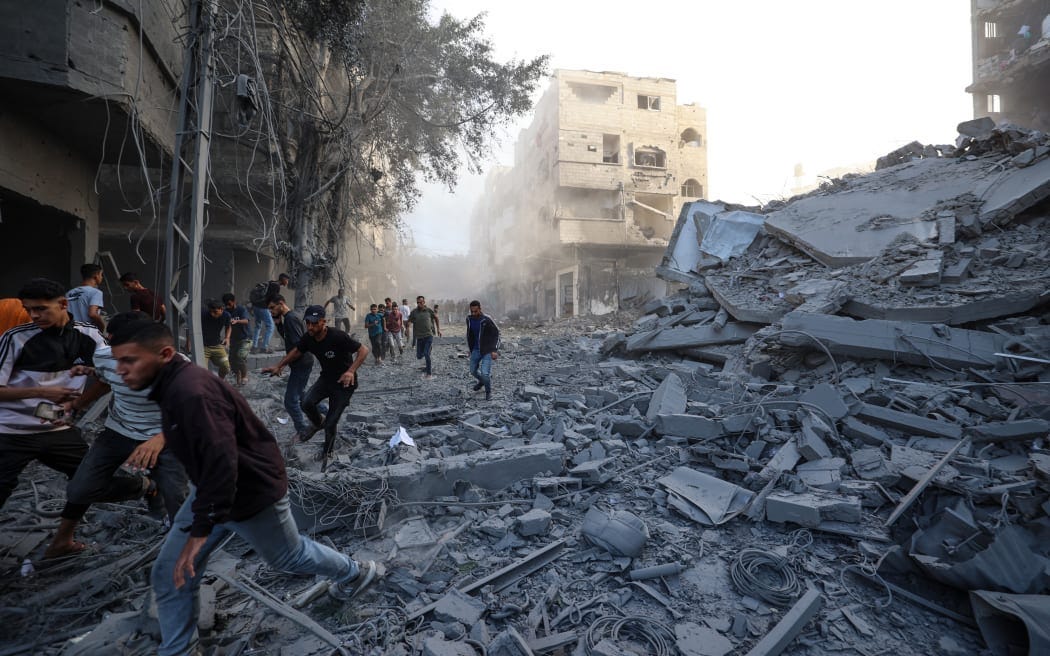
And then, with perfect cynicism, that same devastated landscape is presented as proof that the punished population constitutes a perpetual threat. First they create chaos. Then they point to that chaos as evidence of the oppressed person’s intrinsic barbarism. Finally, that manufactured barbarism is invoked to legitimise a new escalation. A power that materially organises the conditions of the explosion, that sows terror and suffocation for decades, and then uses the reaction incubated by that very regime as licence to intensify the punishment.
The sequence is ancient. Colonialism perfected it on an oceanic scale; modern empires refined it with bureaucracies, maps, and camps. What changes today are the speeds and the infrastructures. The same scheme returns with satellites, drones, server clouds, and hysterical billionaires tweeting like buffoons while administering material capacities for devastation.
This does not end in Gaza or on the outskirts of San Francisco. The same logic is preparing its domestic version.
Chinese internet users have a term for this, taken from video games: kill line, 斩杀线, the execution threshold. It describes the point below which a character can no longer recover—a single hit eliminates them. They made it go viral to talk about American precarity: the point at which one medical bill, one dismissal, one accident triggers an irreversible fall into destitution. The most exact name for the mechanism of Western capitalism was found by its rivals. In a video game.
Artificial intelligence is preparing a massive displacement of that line: millions of people pushed simultaneously below the threshold. What has already been trialled on colonial bodies—human surplus, enclosure, the management of disposability—will now be trialled on whole populations of the developed world. This time there will be no geographical frontier keeping the catastrophe at a prudent distance.
No company can avoid automating, because any one that abstains will be devoured by competition. All of them move in the same direction, even when that direction erodes the conditions that sustain them. Every worker laid off was also a customer, a debtor, a renter. The system is running into its own trap with a mixture of technical lucidity and historical blindness.
Nothing good will come out of that.
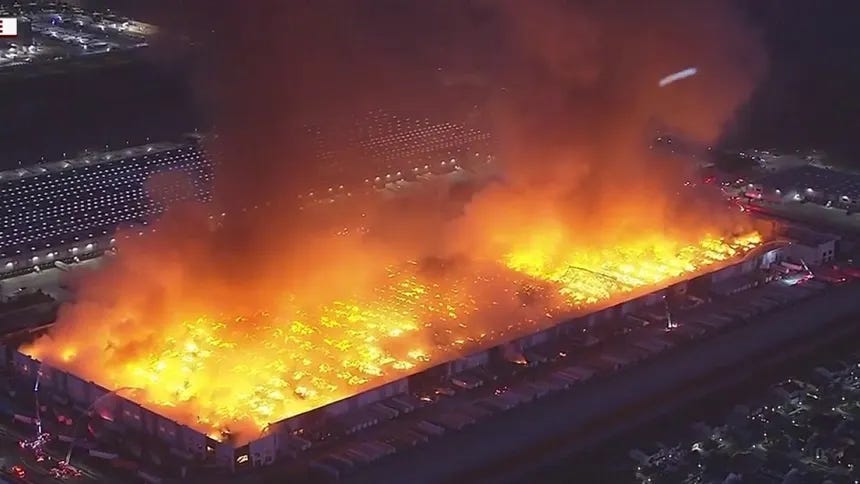
What will come out is rage. A growing sense of having been replaced not only in the factory or on the job, but in one’s very right to exist with dignity within the common world. The neo-Luddite reaction will stop seeming like a romantic relic: sabotage, fires, erratic hatreds, violence against machines and infrastructures. Last Thursday, at four in the morning, someone threw a Molotov cocktail at the front door of Sam Altman’s house in San Francisco. An hour later he was outside OpenAI’s offices threatening to burn them down. He was twenty years old. Luigi Mangione multiplied by millions, with no proper name, no face, none of the tragic elegance of the individual gesture—only the accumulation of a fury the system will have manufactured with the same efficiency with which it manufactured everything else. Another young man set fire to a paper factory in Ontario, California yesterday as well. (12 Oct 2026) Causing losses of 500 million dollars, his message was blunt: “All they had to do was pay us enough to live.”
Stochastic terrorism.
What is most disturbing is not the violence of the system. It is the glee.

The ease with which this regime presents itself as culture, as anti-system courage, as brutal sincerity. The moment when the system stops being ashamed of itself and starts demanding admiration. It wants everyone to understand, without any explicit decree, who rules and who merely receives the right to suffer the consequences.
I think of those Israeli legislators with their bottles of champagne. Of the sparkling wine flowing amid laughter while the law is signed to execute Palestinians—only Palestinians, no other category of human beings, only them. Of the photograph someone must have taken to keep as a souvenir. Of the moment when that image—that specific image—becomes possible, circulates, and brings nothing down.
It is worth pausing over who the protagonists of this film are. It is not Asia. It is not the global South. It is not the barbarians from the story. It is the civilised world. The axis of good. The consolidated democracies, the mature institutions, the countries that drafted the declarations of human rights and built the international courts. The West is not exporting its best version while it sinks: it is exporting its deepest truth, the one that was always there beneath the varnish. Barbarism did not arrive from outside. It was inside, waiting for the varnish to wear thin.
That is what is new.
Not the machines.
Not the wars.
The hysterical glee.