Uncle Doomer

Version en Español
Yesterday in Beijing, an android named Lightning ran a half-marathon in 50 minutes and 26 seconds.
The human world record is 57 minutes and 20 seconds. It belongs to a Ugandan runner named Jacob Kiplimo who trained his entire life to set it. Lightning beat it by nearly seven minutes. Lightning is a Chinese phone with legs.

Last year, the winning robot finished in two hours and forty minutes. In twelve months they went from nearly three hours to under one. The organizers handed out special awards: “Best Endurance,” “Most Graceful Gait,” “Best Perception.” Like someone domesticating something and giving it a name.
One robot face-planted two hundred meters from the start and finished the race with its torso patched together with packing tape. It finished anyway.
Nobody in the stands looked scared.
I am a doomer. Allow me to explain why this is not exactly good news.
Before I go further I need to clear something up, because otherwise my niece Valentina —and Aunt Elvira, and basically everyone— is going to think I’m talking about flat-earthers.
A doomer is not a conspiracy theorist.
The conspiracy theorist invents the cause. The reptilians control the water supply. Bill Gates put chips in the vaccines. They already have the conclusion; the evidence is just paperwork.
That said, it’s worth admitting that lately the conspiracy crowd has been on a hot streak. Not because they have a method — but because “reality” was so fake that even the delusions landed. Governments were mass-surveilling their own citizens. The vaccines had side effects they denied. NASA is a circus. And Pizzagate was literal.
The doomer, by contrast, reads the causes and arrives at conclusions the mainstream still can’t stomach. (It’s the futurological version of the conspiracy theorist.) But the doomer doesn’t invent anything. They look at the data, do the math, and say out loud what comes out. The problem isn’t the method. It’s the result: uncomfortable, premature, impossible to fully ignore.
Being a doomer is like being a weatherman for the apocalypse: you’re always wrong until the day you’re not, and that day nobody’s watching the forecast. The doomer doesn’t ask for vindication. Just takes notes. The problem is that history ends before the notebook does.
Now comes the erudite part, which is also the scatological part. In English these two words don’t sound alike at all — which is frankly a failure of the language. In Spanish, they’re written almost identically, which is not an accident but an act of divine grace.
Eschatology — from the Greek eschaton, meaning “the last” — is the branch of theology that studies the end of times. The Apocalypse. The Last Judgment. The four horsemen, the trumpets, the lake of fire.
Scatology — from the Greek skōr, meaning excrement — is the fascination with shit.
The doomer is a scholar of both. They study the end. And they have to talk about shit all day just to get anyone to listen.
This week Alex Crap, CEO — Chief Execrable Officer — of Palantir, published a manifesto. He titled it The Technological Republic. It’s number one on the New York Times bestseller list.
A few points, quoted verbatim:
Point 5: “The question is not whether AI weapons will be built; it is who will build them and for what purpose.”
Point 6: “National service should be a universal duty. We should, as a society, seriously consider moving away from an all-volunteer force and only fight the next war if everyone shares in the risk and the cost.”
Point 12: “The atomic age is ending. A new era of deterrence built on AI is set to begin.”
Point 21: “Some cultures have produced vital advances; others remain dysfunctional and regressive.”
Point 21 is textbook racism dressed in think-tank prose. Point 6 is universal conscription wrapped in civic language — for Americans, of course. They’re the ones who should go fight. To fight the wars Palantir designs. The rest of us just happen to live in the countries where those wars take place.
The Apocalypse as MVP.
MVP: Minimum Viable Product. You launch with the bare minimum features, fail fast, iterate. The Second Coming has been in beta for two thousand years. Palantir is working on v2.0. And if there aren’t enough volunteers, Point 6 will handle recruitment.
Meanwhile, Iran blockaded the Strait of Hormuz — the pipe through which 20% of the world’s oil flows. Trump, in retaliation, blockaded the blockade. A negation of the negation, as Hegel would say, if Hegel had ever had to explain geopolitics to two plumbers sabotaging the same pipe while everything floods with sewage.
The doomer takes notes.
This week a survey of 2,400 workers also came out.
29% of all employees admit to actively sabotaging their company’s AI strategy. Among Gen Z workers, the number jumps to 44%. Nearly half. What they’re doing: poisoning data, faking metrics, generating garbage outputs so management thinks the technology is broken.

They have a name for it: FOBO. Fear Of Becoming Obsolete.
It makes perfect sense when you look at what their bosses are telling them. Microsoft’s AI chief said all white-collar work could be automated within eighteen months. Anthropic’s CEO said AI could eliminate half of all entry-level jobs. Meta announced it’s replacing mid-level engineers with AI this year. And then, with the same face they use to sell you a subscription plan, they ask you to adopt the tool. And threaten to fire you if you don’t. Accenture monitors weekly login data to decide who gets promoted.
The kicker came from Alex Crap at Davos.
A room full of billionaires. Microphones. Cameras. The man standing on stage with his eyes a little too wide open, his voice a little too intense for the context, the bearing of someone not selling a product but announcing a revelation.
And the revelation was this: “AI is going to destroy humanity’s jobs. You’re screwed.”
Said just like that. Almost shouting. With the visceral satisfaction of someone who’d been sitting on that for years, chewing it in silence, and could finally spit it in the face of a roomful of suits. Swaggering. Vindicated.
The audience applauded.
Alex Crap returned to his seat.
The last time workers systematically destroyed the machines threatening their jobs was the Luddite movement in 1811. History books treated them like idiots. Turns out they were two hundred years early.
Nobody called to tell them.
Back to Beijing.
Among the hundred-plus teams that competed yesterday, there was one special entry. Mini Pi, the tiniest robot in the race. So tiny, so obviously out of its league, so irresistibly adorable, that the organizers invented a prize for it. Its own category. So it could win anyway.

Mini Pi finished the race. Received its award. The organizers applauded.
Lightning had crossed the finish line long before, breaking the human world record, without breaking a sweat, without anyone having invented anything for it.
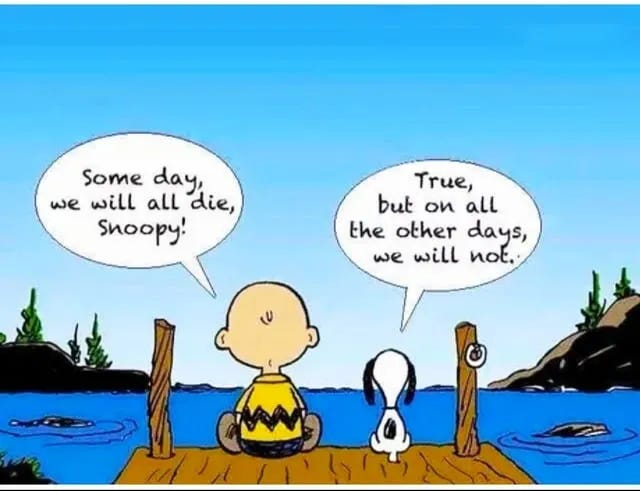
“Some day, we will all diea, Snoopy.” — “True, but not the other days, we will not.”
Being right after the end isn’t being right. It’s being the last one to turn off the lights.